Most guides to making a board game are written for a rainy afternoon: draw a path on cardboard, find some buttons, roll a die. That's a good afternoon. This guide is for a game you want other people to play more than once, and maybe one day to sell.
It follows the order the work happens in. The idea gets proved on paper first. The board and pieces get real sizes once the idea survives. Then come testing, numbers, the rulebook, the look of the thing and a printed copy. Expect to loop back more than once. A game that players ask to play again usually takes several months of weekly testing, and most of what you draw in the first month ends up in the bin.
Start with the decision players make every turn
A board game is a loop: something happens, a player decides, the board changes, the next player decides. The decision is the game. Everything else, from the theme to the board, exists to make that decision interesting.
So before you draw anything, write the decision on an index card in one sentence. "Each turn you either move your caravan or trade at the market you're standing on" is a game. If your sentence needs an "and also" halfway through, you have two games, and it's worth finding out which one you want first.
Then fix four numbers, because each one shapes the board:
- Player count. A board for 2 to 4 players needs spaces that hold four pieces at once.
- Play time. Forty-five minutes with four players taking about a minute a turn is roughly ten rounds.
- Audience. Families, hobby gamers or a single friend group decide how much reading a turn can ask for.
- How someone wins. First to a space, most points, last one standing. The win condition tells you what the board has to track.
The numbers catch problems early. If your track is 60 spaces long and players roll one six-sided die, they move 3.5 spaces a turn on average and need about 17 turns to finish. That doesn't fit in ten rounds, and it's much cheaper to learn that on an index card than on a printed board.
Build the ugly version first
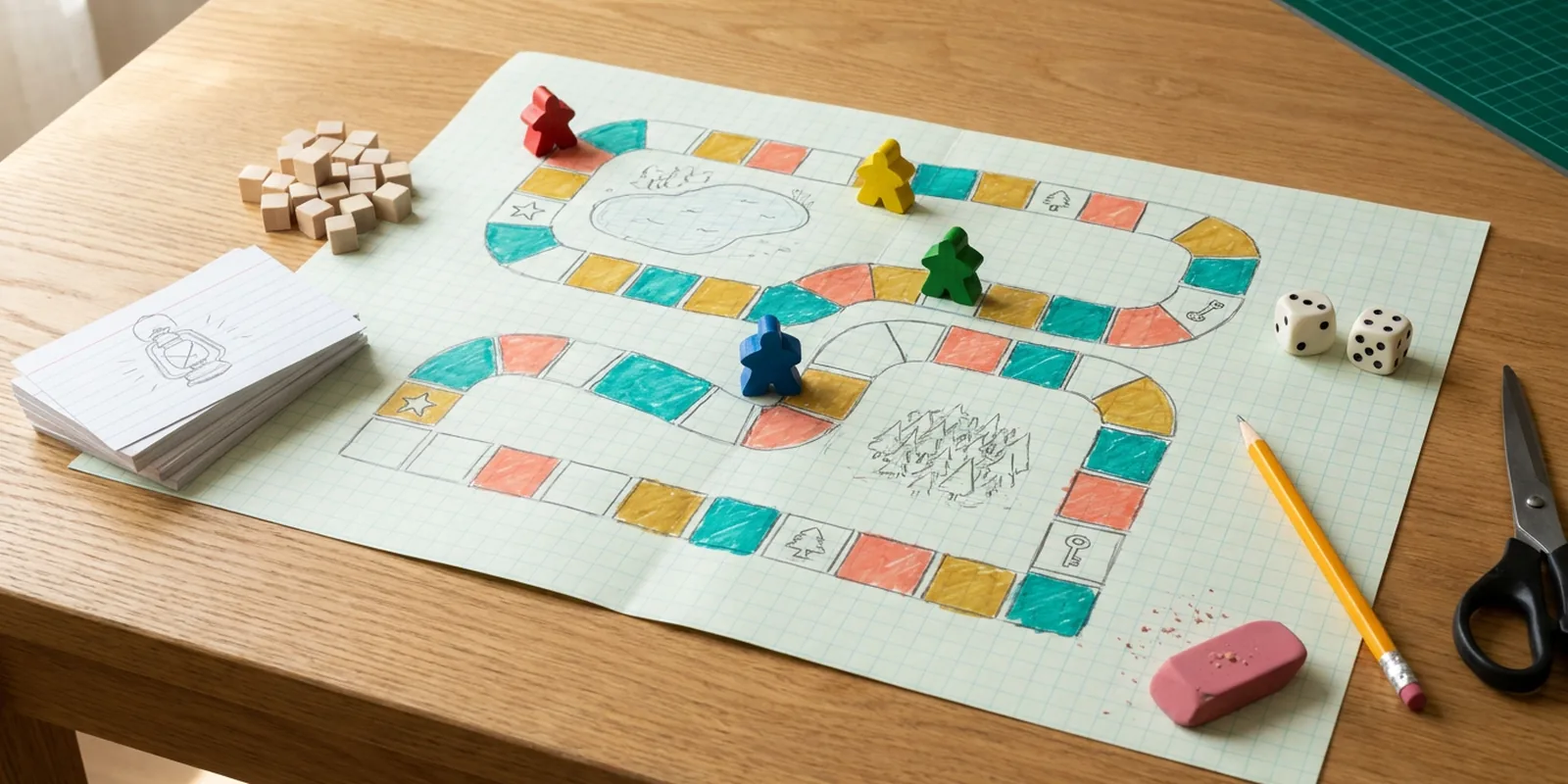
The first prototype should take one evening and cost almost nothing. You need:
- a large sheet of graph paper for the board (11 × 17in or A3 is plenty)
- a pack of 3 × 5in index cards, cut in half so each is 3 × 2.5in, close to a playing card
- pawns, cubes and dice borrowed from games you already own
- a pencil, an eraser and one or two highlighters
Draw the board in pencil. Write each card's effect in plain words, with no art and no name for the game. Put the rules on one side of a sheet of paper. Then play it alone, taking every seat in turn, until you can play five turns without checking the rules.
The paper version has one job: to show whether the core decision is still interesting on the tenth turn. If it isn't, rewrite the index card and play again. This is the cheapest point in the whole project to change your mind.
Design the board
Once the loop works, the board stops being a sketch and becomes a component with a size, a shape and a print file.
Pick the board's shape
The board's shape decides what kind of choices players make, so choose it to suit the decision you wrote down.
| Board type | Good for | Watch out for |
|---|---|---|
| Track (a path of spaces) | Races, scoring tracks, roll and move | The die can end up making the decision for the player |
| Grid (squares or hexes) | Positioning, tactics, movement | Squares make diagonals awkward; hexes give six equal neighbours |
| Area map (regions) | Territory, area control | Region sizes and borders need a lot of testing to feel fair |
| Point to point (nodes and routes) | Routes, networks, travel | Crowded junctions get hard to read |
| Modular tiles | Replayability, exploration | Every tile edge has to match every other tile edge |
Size the spaces from the pieces
Work out the size of a space from the pieces that stand on it, then work out the board from the spaces. A printed meeple is about 0.67 × 0.64in at its base. If four players can land on the same space, four meeples in a square take up about 1.34 × 1.28in, so a space of around 1.5in holds them without the pieces toppling each other.
Now the board size is arithmetic. On an 18 × 18in board, spaces 1.5in deep fit 12 to a side around the edge, which gives a ring of 44 spaces with the corners shared. Put fewer spaces on the ring and each one gets roomier; put more on and you'll need smaller pieces or a bigger board.
Pick a real board size
Pick a size your printer actually makes before you draw the final board. These are the boards The Game Crafter prints, and the same presets ShuffleKit offers:
| Board | Size | Folds | Printed sides |
|---|---|---|---|
| Small Square | 4 × 4in | none | two |
| Quarter | 5 × 5in | none | two |
| Skinny | 4 × 10in | none | two |
| Half | 5 × 10in | none | two |
| Square | 8 × 8in | none | two |
| Large Square | 10 × 10in | none | two |
| Bi-Fold | 9 × 18in | once, across the middle | one |
| Quad-Fold | 18 × 18in | twice, into quarters | one |
The 18 × 18in quad-fold is a common size for a full main board. The small rigid boards work as player boards, side boards or the whole board of a small game. Other printers offer other sizes, so if you're printing elsewhere, check their list first.
Keep the folds and edges clear
A folding board creases where it hinges. Keep text, small icons and anything a player needs to read off the fold lines, and centre spaces between the creases rather than across them. A path can cross a fold, but the space it crosses on shouldn't carry a rule.
At the edges, the printer trims the board after printing, and the trim wanders a little. Extend your background art 1/8in past the edge on every side (the bleed) and keep anything important at least 1/8in inside it. Work at 300 pixels per inch: an 18in board is 5,400 pixels across before bleed, which is why a phone photo of your sketch won't print well.
Decide what else lives on the board
Every piece of information printed on the board is a question players don't have to ask. Good candidates:
- a score track around the edge, 0 to 50 or 0 to 100
- spaces for the draw and discard piles, sized to the cards with a little margin
- a round tracker, if the game has a fixed length
- a short turn summary in a corner
Plan the rest of the box
A board game is rarely only a board. Start from what the game needs, because every extra kind of component adds cost and setup time.
- Cards. Poker size, 2.5 × 3.5in, is the standard for anything held in the hand. Keep the deck in a spreadsheet with one row per card, so a rules change is one column edit rather than forty files. Our guide to playing card sizes has every size in inches, millimetres and pixels.
- Tokens and tiles. Punched cardboard comes in more shapes than people expect: round and square chits from 0.5 to 1in, square tiles of 2 and 3.5in, hex tiles from 2 to 3.75in wide, triangles and standees. ShuffleKit offers 13 of these shapes, all printable at The Game Crafter.
- Player mats. Anything from a 4 × 3in placard to a 10 × 10in mat, printed on both sides if factions differ.
- Dice. Stock dice are cheap. Custom faces print on a D4, a 16mm D6 or a D8; for a d10 or d20, use stock dice.
- Pawns. A printed meeple or a cardboard standee carries your art. Plain wooden pieces are cheaper.
- Score pads. From 3.5 × 5.5in up to 8 × 10in, if the game scores on paper.
The box itself is a separate print product with its own template from the printer. Choose it last, once you know what has to fit inside.
Playtest until the numbers stop moving
This is where most of the design happens.
Start alone, playing every seat. Then play with friends, and keep your mouth shut beyond reading the rules. Note where people hesitate or ask what something means, and when they reach for their phones between turns. Change one thing between sessions. If you change three, you won't know which change fixed the problem or caused the next one.
Watch for the classic failures:
- Downtime. Players waiting too long between turns. Shorter turns or something to do on other players' turns fixes it.
- The runaway leader. Whoever leads at the halfway point always wins. Some catch-up mechanism is needed, or the second half isn't worth playing.
- Kingmaking. A player who can't win decides who does.
- First-player advantage. Log who went first and who won. After ten games, the pattern is visible.
Keep that log in a spreadsheet: date, player count, who won, the scores, how long it took, and what you changed. It turns "it felt better" into something you can check.
The last test is the blind one. Hand the game to people who have never seen it, with only the rulebook, and watch without saying a word. Everything they get wrong is a rulebook problem.
If your testers aren't in the room, play online. Tabletop Simulator, Screentop.gg and Tabletopia all run board games, and we compared them in the best card game playtesting software. ShuffleKit's online playtable seats six players plus ten spectators, with the board fixed at the bottom of the table, tokens loose on top and dice that roll. A session there needs a card deck in it, so it suits a game with cards.
Balance it with numbers
A few sums catch problems that playtests take weeks to show.
Dice. One six-sided die averages 3.5 and every face is equally likely. Two dice are different: a 7 comes up 6 times in 36 (about 17%), while a 2 or a 12 comes up once in 36 (under 3%). The middle three totals, 6, 7 and 8, cover 44% of all rolls. So a reward on a 12 almost never happens, and a penalty on a 7 happens constantly. Put your most important results where you want them to land.
Cards. If 4 of your 40 event cards are disasters, a player who draws 5 cards sees at least one disaster about 43% of the time. Draw 3 instead and it drops to about 28%. The deck's makeup decides how often the dramatic moments happen, and it's worth doing that sum before a playtest tells you the game is too harsh.
Costs and rewards. List every action with what it costs and what it pays back, in the same spreadsheet as your cards. The action with the best ratio is the one players will find within three games. Either make it cost more or make sure the game is still fun when everyone does it.
For card-heavy games, how to balance a trading card game goes further into costs and curves.
Write the rulebook last
Rules change after nearly every session until the game settles, so test with a one-page rules summary and write the full rulebook when the changes get small.
A reader should be able to follow it in order:
- What the game is about and how you win, in the first paragraph.
- The components, with counts.
- Setup, with a diagram or a photo of the table.
- A turn, step by step.
- How the game ends and how to score it.
- Edge cases and questions from playtests, at the back.
A one-page reference on the back cover saves a lot of page turning. Then blind test the rulebook the same way you blind tested the game.
Draft the rules wherever you like. ShuffleKit's Docs & Rules keeps them in the same project as the components they describe, but it isn't a page-layout tool, so lay out the printed booklet in something like Affinity Publisher or InDesign.
Make it look like a real game
On a board game, most graphic design is information design.
- Use icons for anything that repeats. A small coin symbol reads faster than the word "gold" printed forty times.
- Give each player and each resource one colour, and use it everywhere.
- Don't let colour carry information on its own. About 1 in 12 men has some colour vision deficiency, so pair every colour with a shape or an icon.
- Board text is read from across a table, so make it bigger than card text and keep it horizontal where you can.
Commission art last, once the rules have stopped moving; placeholder art is fine all the way through testing. If you plan to pitch the game to a publisher, you usually don't need final art at all, because publishers tend to bring their own artists. The graphic design rules for game cards apply to boards and tiles too.
Print a real copy
Most games are printed at home, then on demand, long before anyone orders a manufactured run.
Print at home. Print the board in sections on cardstock, spray-mount them onto chipboard or foam board, and trim. It's cheap and slow, and it's the right choice while the board is still changing every week.
Print on demand. The Game Crafter prints single copies with no minimum order, and bulk discounts start at ten. Order one copy of your prototype to check the colours and the folds before you order more. It's also the quickest way to learn what every component costs, because the price updates as you add pieces.
Manufacture a run. For a Kickstarter or a retail release, offset printers such as PrintNinja and Panda make runs of a thousand copies and up, where the unit price drops sharply and the upfront bill runs to thousands. If you'd rather a publisher took that on, you'll need a prototype, a rulebook and a one-page sell sheet; our guide to publishing a card game covers the pitch, and most of it applies to board games.
Where software fits
Paper comes first. Software starts to pay off once a rules change means rewriting forty cards by hand, or once your testers live somewhere else. It's also the easiest way to get print files at exact sizes with bleed.
General design tools like Illustrator, Affinity or Canva handle the art. Data-driven tools like nanDeck, Dextrous and Component Studio generate whole decks and tile sets from a spreadsheet. We compared them in the best board game makers.
ShuffleKit's board game maker keeps the board, the decks, the tokens, the dice and the mats in one project. You can playtest them on the online table, then order the printed components through The Game Crafter. You can start with the board game card templates or a blank project. The free plan covers one project with up to 120 cards and unlimited playtest sessions; exporting print files needs a paid plan. It has two gaps: there's no rulebook layout, and custom dice stop at D8.
Common questions
How long does it take to make a board game?
A playable paper prototype takes an evening. A game that strangers enjoy usually takes several months of weekly playtesting, and designers who get published often talk about a year or more from first prototype to release.
How much does it cost to make a board game?
The paper prototype costs next to nothing. A single printed copy depends entirely on the components, so price your list at a print-on-demand printer before you commit to it. A manufactured run of a thousand or more copies costs thousands up front, which is why many designers crowdfund or pitch to a publisher.
Do I need to be able to draw?
No. A prototype has to be readable, and plain icons with clear text carry a game through testing. Publishers generally hire their own artists for a game they sign.
Can I make a board game online?
Yes. You can design every component and order printed copies without installing anything, and test with players who aren't in the room. A board game maker like ShuffleKit does that in one project, and Screentop.gg or Tabletopia can also host the online sessions.