Make your own trivia game, with cards to print
Write the questions in a sheet or ask the AI for them, and each card takes its category's colour, its answer and its points. Then print the deck with a board and a score sheet for game night.
Most trivia makers build a quiz for a screen
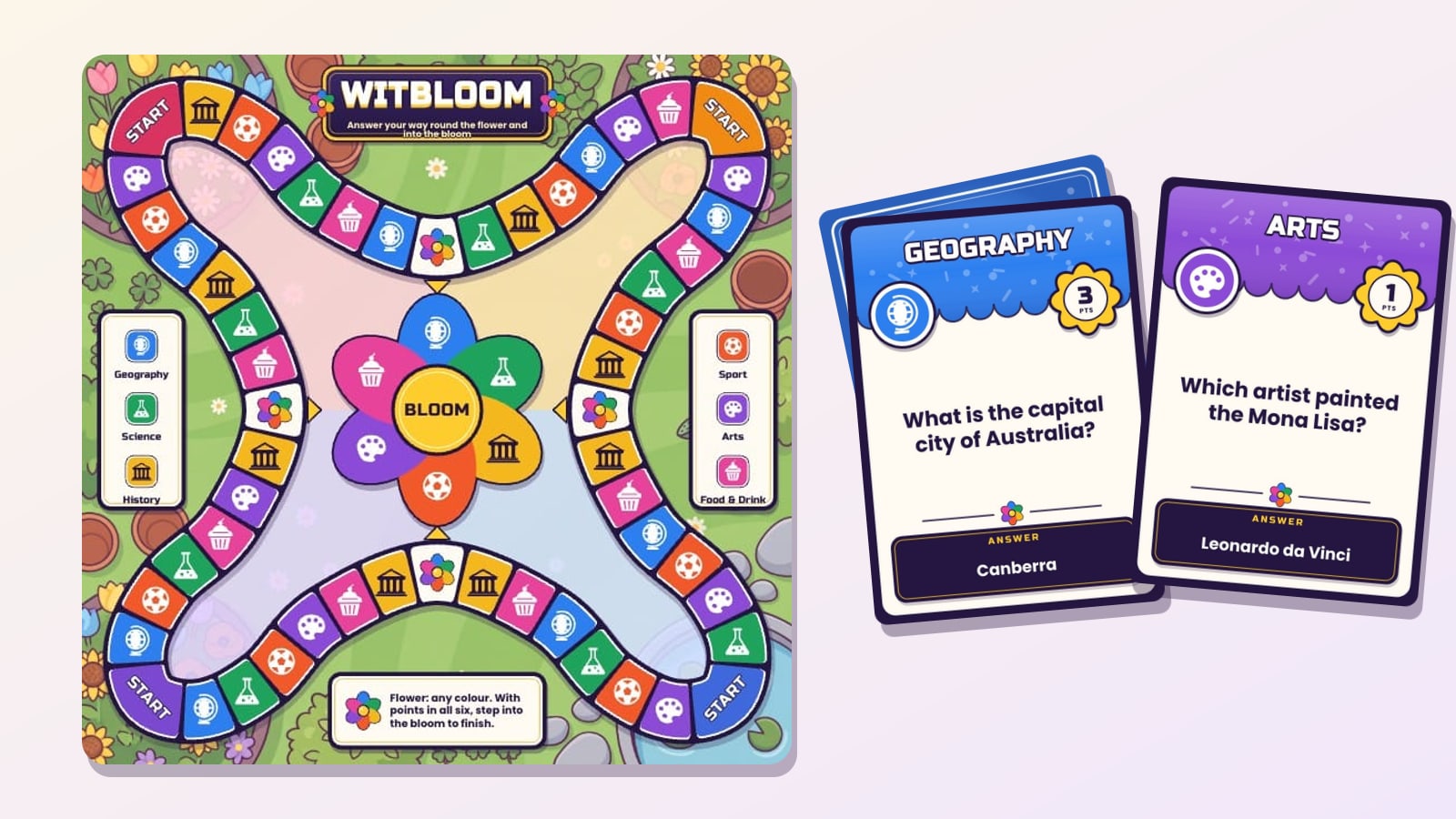
Search for a trivia game maker and you get quiz apps: a host runs the game on a TV or a laptop and everyone answers on a phone. This page makes a deck of question cards with the answers on them, a board to move round and a score sheet, for a table where nobody needs a device. It is the kind of game people hand out at a wedding or bring out on a family holiday.
 1
Start from Witbloom
A whole trivia game: a board, 48 question cards in six categories, four pawns, a number die, a score sheet and a tuck box. Change any part of it, or draw your own card in the same editor.
 2
Write your questions
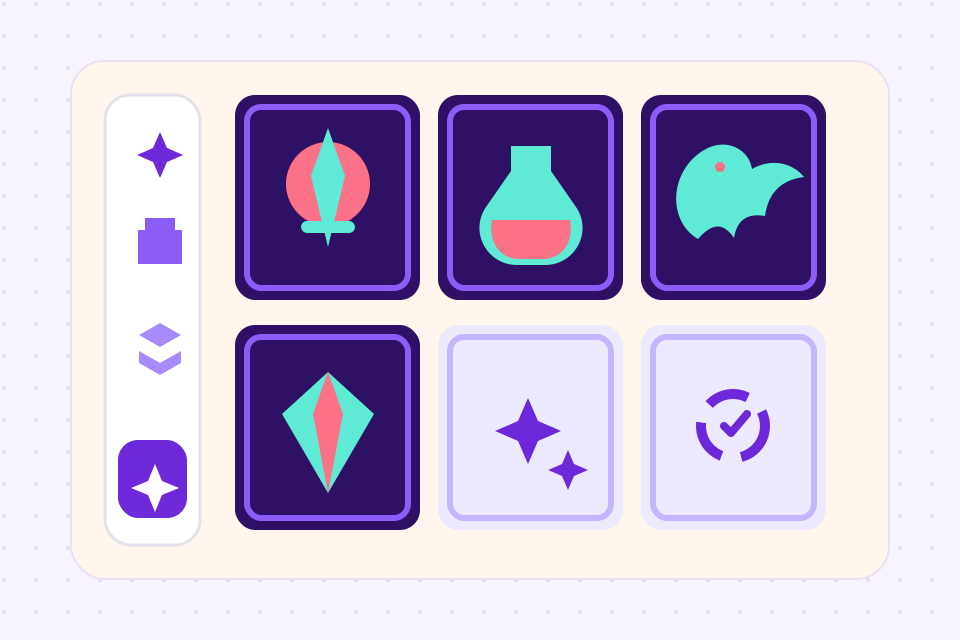
Each card is a row in a sheet with its question, answer, category and points. Type them, import a spreadsheet, or ask Shufflo, the AI assistant, for a batch on any subject.
 3
Play a round, then print
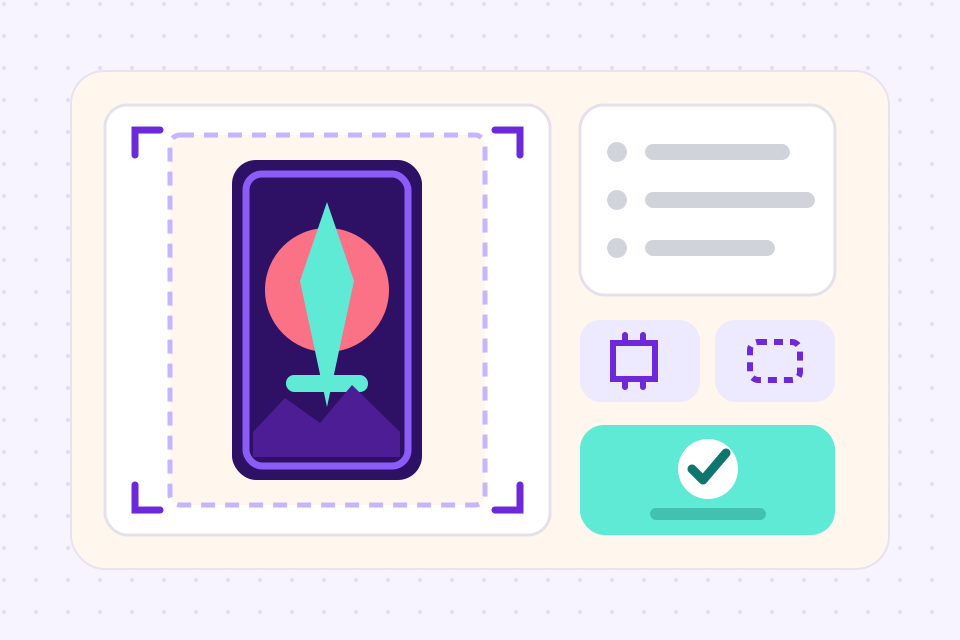
Deal the deck on the online table with friends from a link. Then print a PDF at home or order the game, boxed, from The Game Crafter.
How to make a trivia game
The questions take longest, so most of this is about them. The steps follow Witbloom, the trivia game in our template gallery, and work just as well for a deck you design yourself.
Pick the categories
A category gives every player a subject they are good at and tells the reader which pile to draw from. Witbloom has six: geography, science, history, sport, the arts, and food and drink. Dunewise, the Islamic quiz game, has five.
For a game about one subject, split the subject. A wedding quiz might be How they met, Travels, Food, Family and Friends; a film night might be decades or genres. Give each category a colour, because the colour is what players read across the table.
- Four to six categories keep each pile thick enough for a full game.
- Aim for the same number of questions in every category, so no colour runs out first.
Write the questions and answers
Type each question into its own row with its answer, its category and its points, or paste the lot from a spreadsheet with a column for each. Witbloom plays with 48 cards, eight per category; a deck you want to bring out more than once needs more.
Shufflo, the AI assistant, writes questions too. Ask for "40 questions about 90s films in four categories, 1 to 3 points each" and it writes up to 50 rows into the sheet at a time. Read every answer before you print: the AI gets facts wrong sometimes, and a wrong answer on a printed card starts an argument.
- One fact per question, with one answer everyone will accept.
- Write the answer the way the reader will say it out loud: "Canberra", not "Canberra (capital since 1913)".
- Use the points for difficulty: a 1-point question a child can answer, a 3-point one most adults miss.
Put the answer on the card or on the back
Witbloom prints the answer in a dark box at the foot of the card. The player on your left draws the card, reads you the question and sees the answer straight away, which suits a game where someone always reads.
For a deck people quiz themselves with, put the answer on the back instead, the way the Flipwren flash cards do. The print PDF lines each back up behind its own question, so a double-sided print keeps every answer with its card.
Choose the scoring and the board
The simplest scoring is the card's points: answer right and write them in your category's row of the score sheet. Witbloom's sheet has a row for each category and a column for each of four players or teams, plus a bonus for the player who ends the game.
A board decides which category you answer next. Witbloom's track is coloured spaces round a flower, and a number die moves you along it. Leave the board out for a pub quiz: teams write their answers down, a host reads the cards, and the score sheet keeps the rounds.
Play it online first
Put the board and the deck on the online table and send the link. Up to five friends join as guests in the browser, with nothing to install, and you can roll the die and move the pawns as you would at home.
Play a few rounds and note the questions nobody gets and the ones everybody gets. Change those rows in the sheet and every card that uses them redraws.
Print it
Export a print PDF with cut lines, on the Hobby plan from $4 a month billed yearly, and print it on card stock at home. Print one sheet first and hold it against the light to check the backs line up before you print the rest.
Or order the game from The Game Crafter with Print & Ship, on the Indie plan: the cards come cut, and the price is shown before you order a copy.
- Cards are poker size, 2.5 × 3.5 inches, nine to a sheet of Letter or A4.
- Print at actual size, with "fit to page" turned off, on card stock of 250 to 300 gsm (90 to 110 lb cover).
What the maker does with each question
Set a card's Category and its band, icon and back change to match. A new question sorts into the right pile without you redrawing anything.
Import a CSV or a Google Sheets export with a column for the question, the answer, the category and the points. Two hundred questions take as long as twenty.
Ask Shufflo for questions on any subject and it writes up to 50 rows at a time into the sheet, with answers and points. The free plan includes 20 messages a month.
Each card carries its own points, and the printable score sheet has a row per category and columns for four players or teams.
Witbloom's 8 × 8 inch board, its bulb pawns and its die sit in the same project as the deck. Redraw the board, or drop it and play from the cards alone.
Print the PDF at home, or order the deck, the board and the tuck box from The Game Crafter with Print & Ship.
Quiz games you can start from
Each is a template in our gallery, made in ShuffleKit. Add one to a project and rewrite every question in it.
- Trivia board game
Witbloom
48 question cards in six categories, each with its answer and 1 to 3 points, a four-petal flower track, bulb pawns, a number die, a score sheet and a tuck box.
- Islamic quiz game
Dunewise
40 question cards in five categories, from the Quran to good manners, a desert map, a category die, lantern pawns and a score sheet. No person is drawn anywhere.
- Flash cards
Flipwren
A question on the front and its answer on the back, in three subject colours, for a deck people quiz themselves with rather than score.
- Blank boards
Slatemoor
Four plain boards, among them a loop track with spaces for a draw pile and a discard pile, for a trivia game with a board of your own.
Frequently asked questions
Everything you need to know before getting started.
Still have questions? Contact us
Is the trivia game maker free?
Your first game is free to make: one project of up to 120 cards, which holds all of Witbloom with room for more questions, and you can play it online with friends. Downloading print PDFs starts on the Hobby plan at $4 a month billed yearly, and Print & Ship is on the Indie plan.
How is this different from an online trivia maker?
Tools such as TriviaMaker, Kahoot and Jotform's quiz maker build a quiz that runs on a screen, with a host, a timer and answers typed on phones. This one makes a physical game: printed question cards with the answers on them, a board and a score sheet. If you want a quiz on a projector, use one of those. If you want a deck to play at a table or give as a present, start here.
How do I make my own trivia game?
Choose four to six categories and give each a colour. Write the questions in a sheet, each with its answer and its points, or ask the AI for them and check every answer. Decide whether the answer goes on the card or on the back, and whether the game has a board or is scored on a sheet. Play a few rounds online, fix the questions that are too easy or too hard, then print.
Can the AI write the trivia questions?
Yes. Tell Shufflo the subject, the categories and how hard the questions should be, and it writes up to 50 questions at a time into the sheet with their answers and points. It reads the questions already in the sheet first, so you can ask it to avoid repeats. Check the answers before printing, as it can get a fact wrong. Free accounts get 20 Shufflo messages a month.
Can I make trivia cards for a wedding, a bridal shower or a birthday?
Yes, and these are the decks people most often want printed. Make the categories about the people: how the couple met, places they have lived, family and friends. Change Witbloom's title and colours to match the day, put a photo on the box, and print a deck for each table, or order boxed copies to give away.
Can I make a trivia game about my own family?
Yes. Write the questions about your family's holidays, recipes and stories, with 1-point questions the youngest players can answer. Witbloom's score sheet takes four players or four teams, so a big family can play in teams.
Can I use it for classroom trivia?
Yes. Write the questions from the lesson, print a deck for each group, or put the board on the online table and play it with the class on one screen. There are no student accounts: anyone who joins from the link plays as a guest.
How is a trivia game different from flash cards?
Flash cards are for learning: one person reads the question, turns the card and checks the answer, and nobody keeps score. A trivia game has categories, points and a winner, and someone else usually reads the card. The two decks are built the same way here, so a set of flash cards can become a quiz by adding categories and points. Flash card templates.
Can I make custom cards for Trivial Pursuit?
You can make your own deck in that style, though ShuffleKit is not affiliated with Hasbro and Witbloom is an original design. A card in that style holds six questions, one for each category colour, with the answers on the back. Draw a card with six question lines and six answers in the editor, or keep Witbloom's one question per card, which is easier to read and to print.
What size are the trivia cards?
Poker size, 2.5 by 3.5 inches, which is 750 by 1050 pixels at 300 DPI. Nine fit on a sheet of Letter or A4, and poker is the size Print & Ship orders from The Game Crafter. You can change the card size before you start designing.
Can I sell a trivia game I make with it?
Yes. Witbloom's design is original and the questions you write are yours, so the finished game can be sold. Questions copied from a published quiz book or another game's cards are not, so keep a deck of those for your own table.
Related tools
Board Game Maker
A board game is never one component. Design the board, the deck, the tokens, the dice and the box in one project in your browser, playtest them together, and send the whole thing to print at once.
CSV to Card Game
Drop in a spreadsheet, get a deck. Map columns to card fields, bulk-edit in grid view, and push print-ready files in one click.
Playtest Card Game Online
Share a link, sit your playtesters at a virtual table, and watch your game in motion. No TTS license, no install, no setup.
Card Game Printing
Design the deck here, then send it to The Game Crafter from the same project. They print it on demand and ship it worldwide, so your first order can be a single proof copy.
Trivial Pursuit is a trademark of Hasbro. ShuffleKit is not affiliated with or endorsed by Hasbro. The Witbloom cards, board and sample questions are an original design and contain none of Hasbro's art, logos or questions.
Ready to build it?
Start free. Upgrade only when you're ready to publish.