
Rumblenest Dinosaur Board Game Template
by ShuffleKit
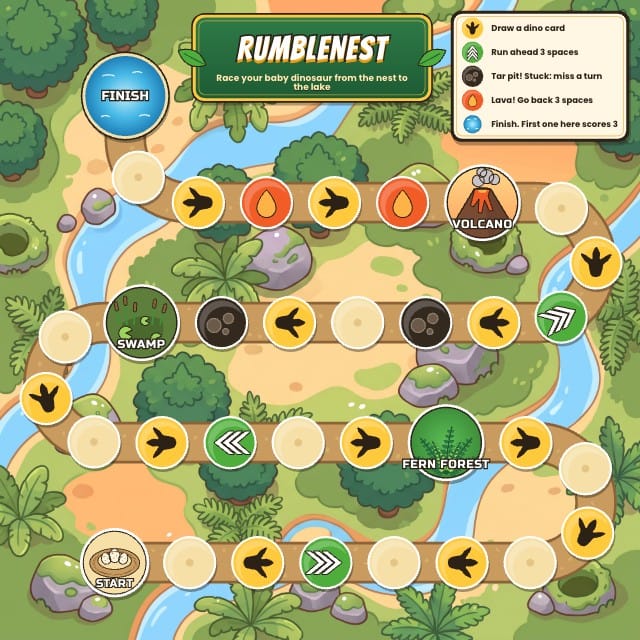
A printable dinosaur board game for kids with 30 dinosaur fact cards: race a baby dinosaur from the nest to the lake and collect dinosaurs as you go. It is a whole roll-and-move game to make your own, in a bright picture-book look: a game board at 8 × 8 inches where a dirt trail runs from a nest of eggs through the fern forest, past the swamp and round the volcano to the lake, with footprint spaces that draw a card, boost spaces, tar pits and lava; poker-size dino cards in three kinds on one back, where each Dinosaur card shows a picture of a real dinosaur (from Coelophysis to Tyrannosaurus rex) with its period, its length in metres, whether it ate plants or meat and a fact about it, and Boost and Hazard cards send a dinosaur ahead or back; a baby dinosaur standee for each of four players; a six-sided number die; a score sheet that counts each player's dinosaurs by period; and a poker tuck box laid out flat on its dieline. Every name, fact and number is text you can retype or import from a spreadsheet, and every picture can be swapped. Comes with 42 sample cards and the rules to play it as it ships.
Boards
- Designs
- 1
- Sample boards
- 1
- Board size
- Square Board — 8 × 8 in
- 203.2 × 203.2 mm · 2400 × 2400 px at 300 DPI
- Board fields
- Name
- Artwork
- Subtitle
Cards
- Designs
- 4
- Sample cards
- 42
- Card size
- Poker — 2.5 × 3.5 in
- 63.5 × 88.9 mm · 750 × 1050 px at 300 DPI
- Card fields
- Name
- Artwork
- Description
- Diet
- Period
- Length (m)
- Steps
- Card Type
Tokens
- Designs
- 1
- Sample tokens
- 4
- Token size
- Medium Standee — 0.75 × 1.68 in
- 19.1 × 42.7 mm · 225 × 504 px at 300 DPI
- Token fields
- Name
- Artwork
- Kind
Dice
- Designs
- 6
- Sample dice
- 1
- Die size
- D6 — 0.6 × 0.6 in
- 15.2 × 15.2 mm · 180 × 180 px at 300 DPI
- Die fields
- Name
Score Pads
- Designs
- 1
- Sample score pads
- 1
- Score Pad size
- Small Score Pad — 3.5 × 5.5 in
- 88.9 × 139.7 mm · 1050 × 1650 px at 300 DPI
- Score Pad fields
- Name
- Subtitle
Boxes
- Designs
- 1
- Sample boxes
- 1
- Box size
- Poker Tuck Box, 54 cards — 7.75 × 6.5 in
- 196.9 × 165.1 mm · 2325 × 1950 px at 300 DPI
- Box fields
- Name
- Artwork
- Subtitle
- Description
Adding a template copies its one board design, four card designs, one token design, six die designs, one score pad design, one box design, their fields, one sample board, 42 sample cards, four sample tokens, one sample die, one sample score pad and one sample box into one project of your own, in one go. Your copy is yours, and later changes by the author never touch it.
Part of print and play games
What’s in Rumblenest Dinosaur Board Game Template
Boards
One board design, square board size, 8 × 8 in: Dinosaur Trail Board.
The boards live in a sheet of their own, one row each, with a column for every field their designs read: Name, Artwork and Subtitle. One row arrives filled in as sample board.
Cards
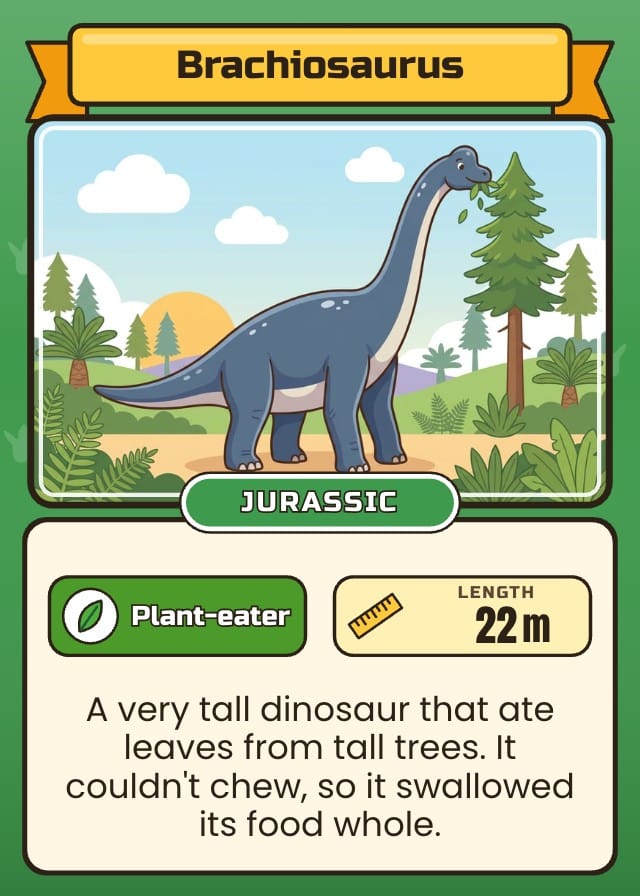
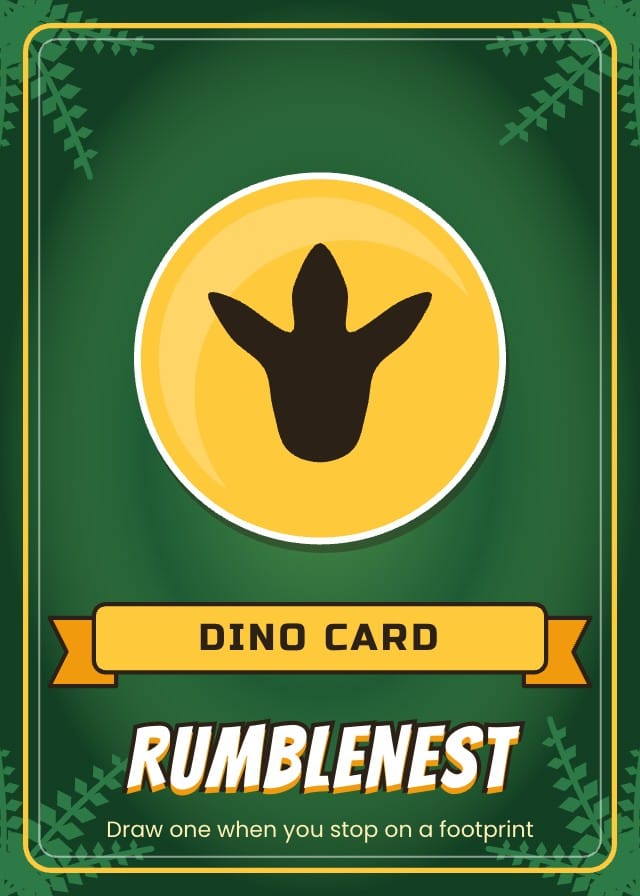
Four card designs, poker size, 2.5 × 3.5 in: Dinosaur Card, Boost Card, Hazard Card and Dino Card Back.
The cards live in a sheet of their own, one row each, with a column for every field their designs read: Name, Artwork, Description, Diet, Period, Length (m), Steps and Card Type. 42 rows arrive filled in as sample cards.
Tokens
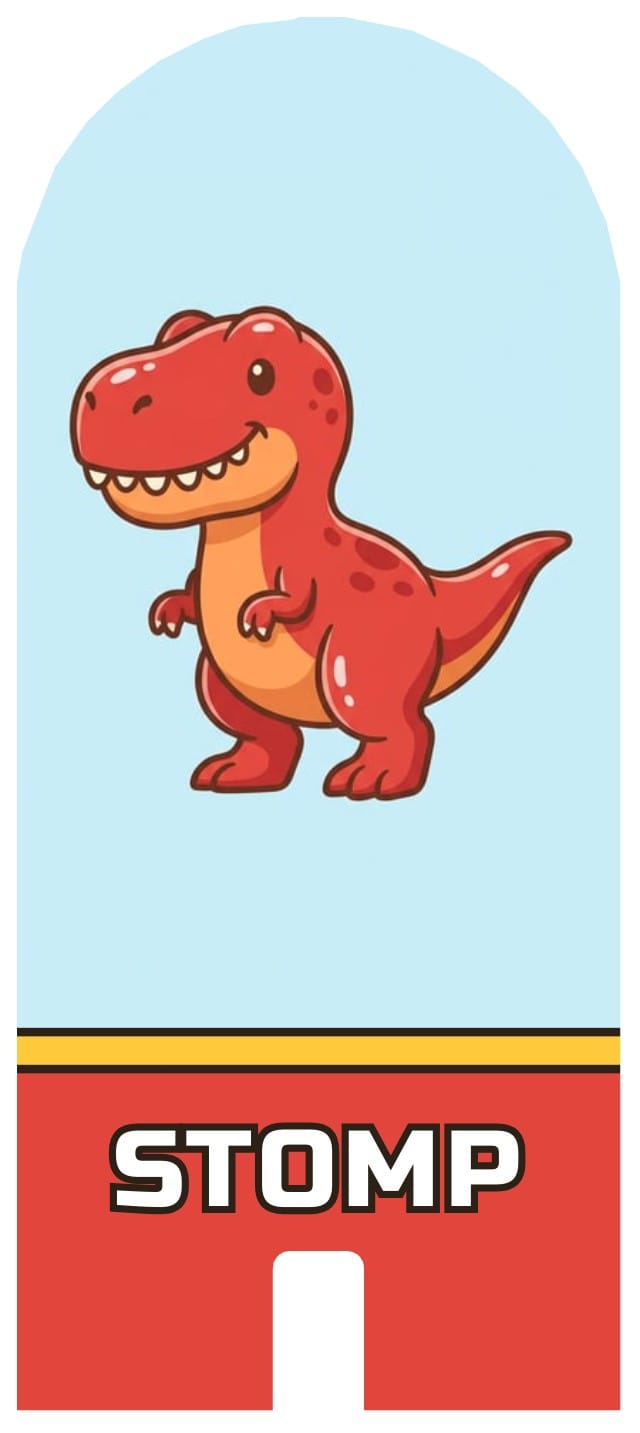
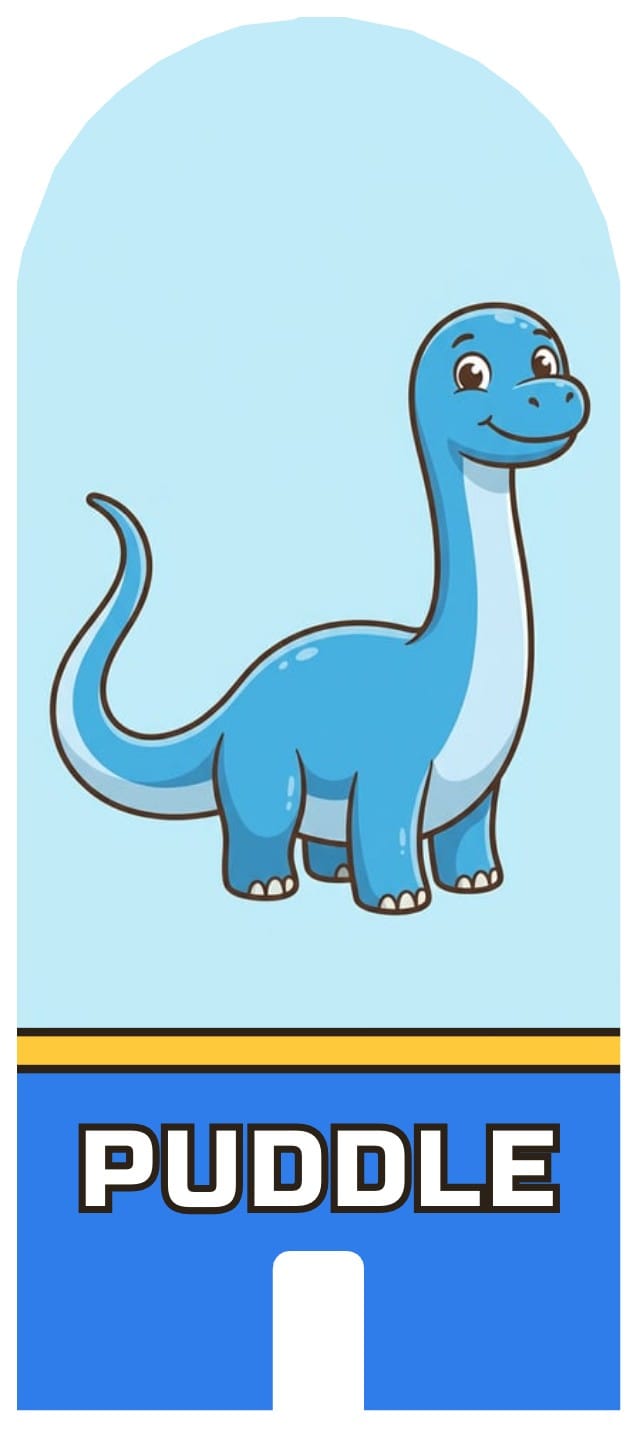
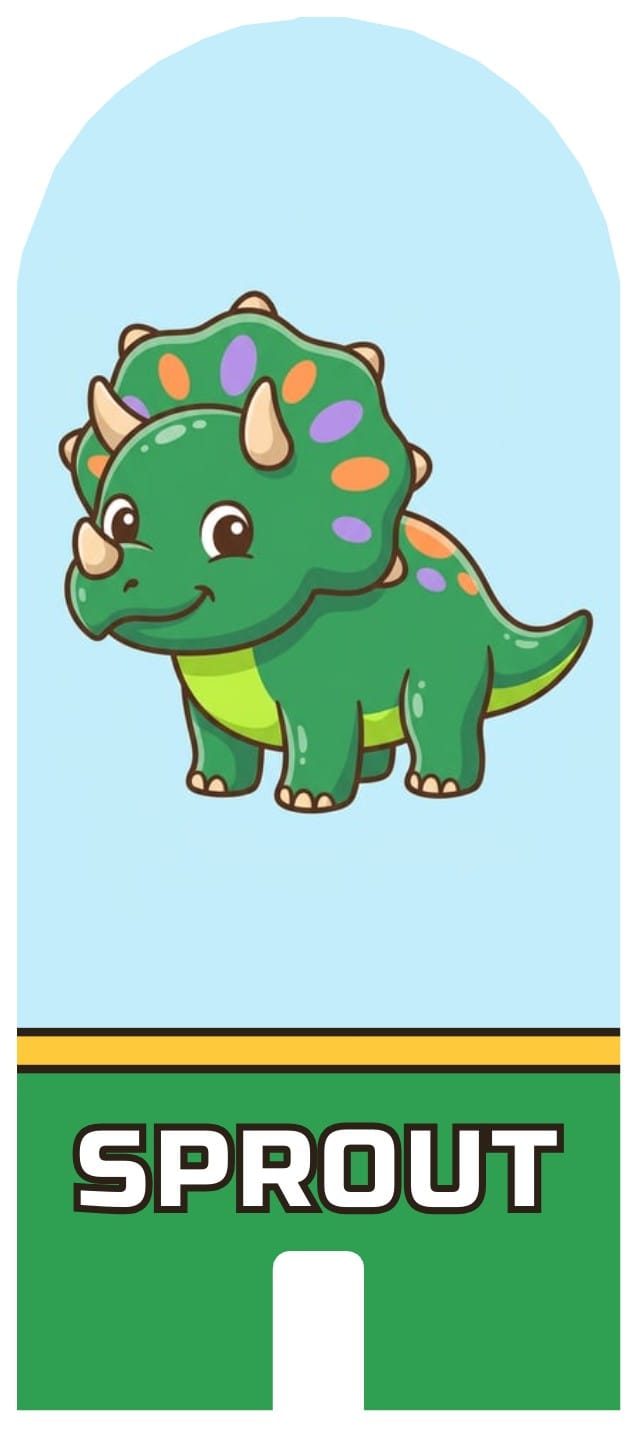
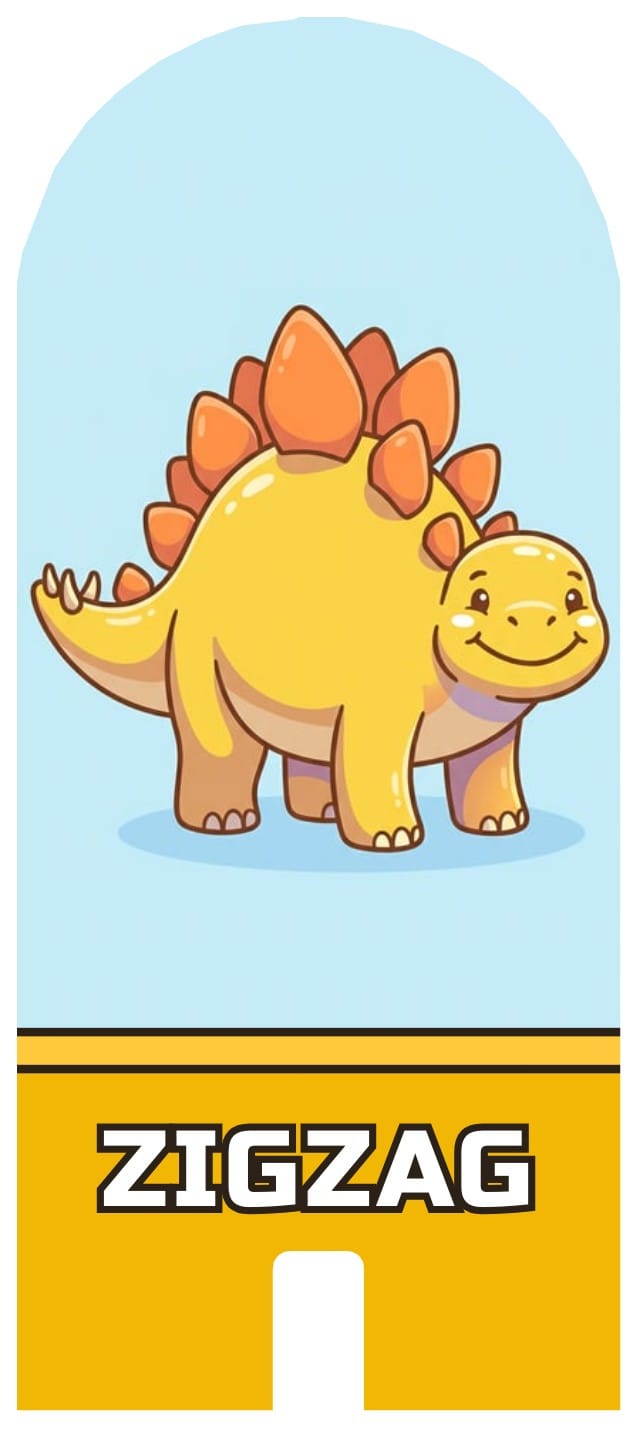
One token design, medium standee size, 0.75 × 1.68 in: Dinosaur Standee.
The tokens live in a sheet of their own, one row each, with a column for every field their designs read: Name, Artwork and Kind. Four rows arrive filled in as sample tokens.
Dice
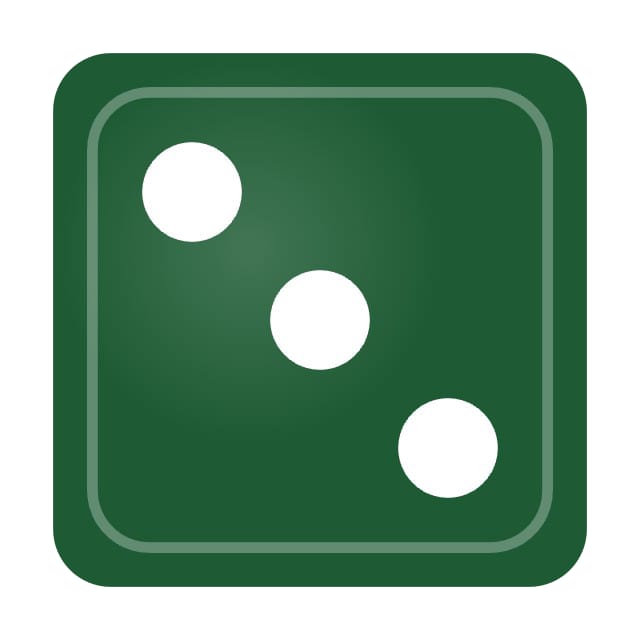
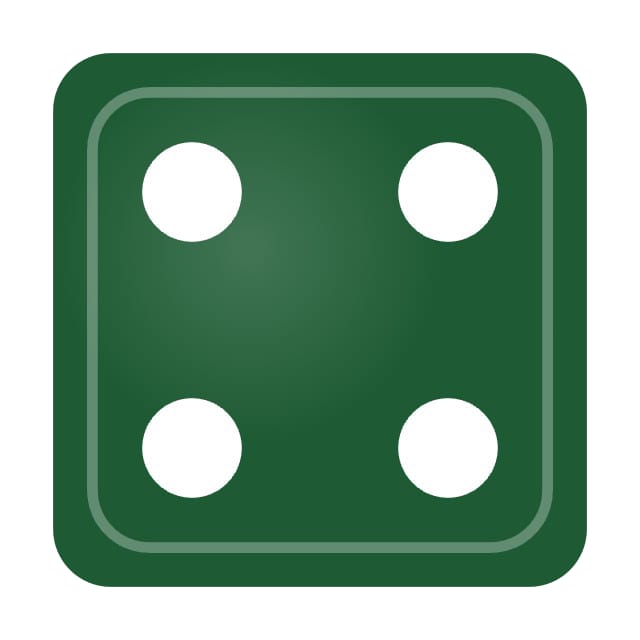
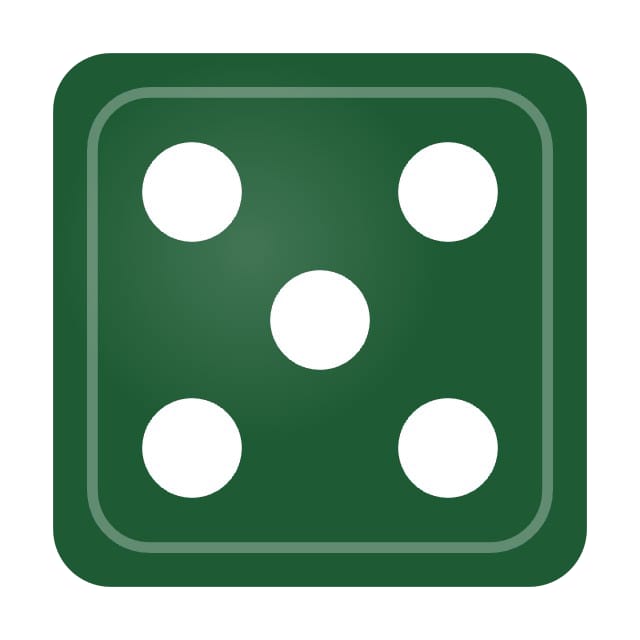
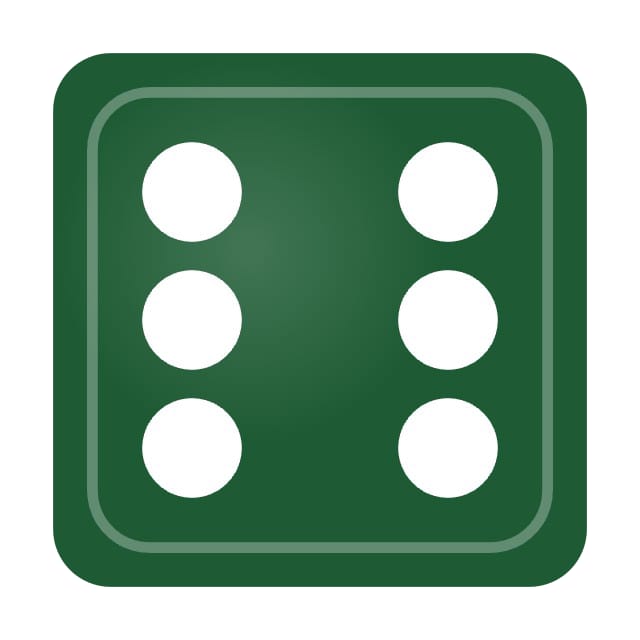
Six die designs, d6 size, 0.6 × 0.6 in: Number Die, Face 1, Number Die, Face 2, Number Die, Face 3, Number Die, Face 4, Number Die, Face 5 and Number Die, Face 6.
The dice live in a sheet of their own, one row each, with a column for every field their designs read: Name. One row arrives filled in as sample die.
Score Pads
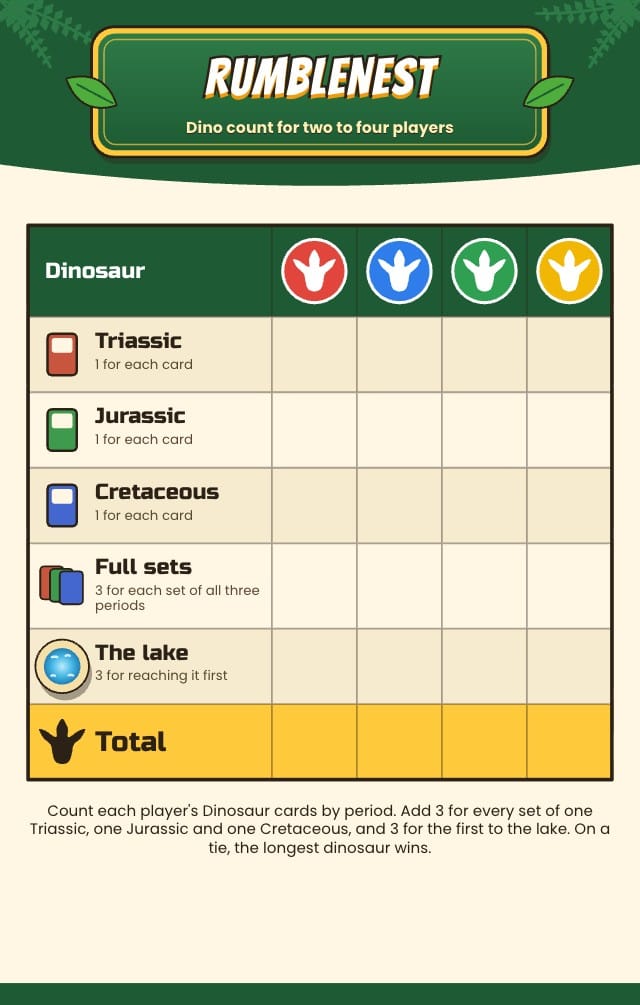
One score pad design, small score pad size, 3.5 × 5.5 in: Score Sheet.
The score pads live in a sheet of their own, one row each, with a column for every field their designs read: Name and Subtitle. One row arrives filled in as sample score pad.
Boxes
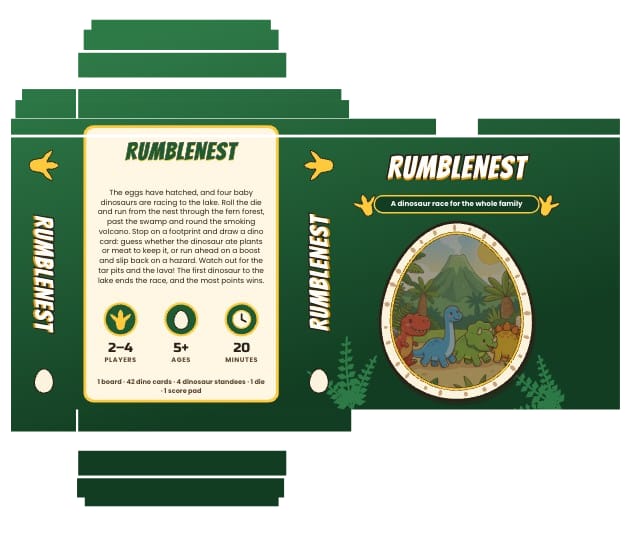
One box design, poker tuck box, 54 cards size, 7.75 × 6.5 in: Tuck Box.
The boxes live in a sheet of their own, one row each, with a column for every field their designs read: Name, Artwork, Subtitle and Description. One row arrives filled in as sample box.
Read the 42 sample cards
| Name | Description | Diet | Period | Length (m) | Steps | Card Type |
|---|---|---|---|---|---|---|
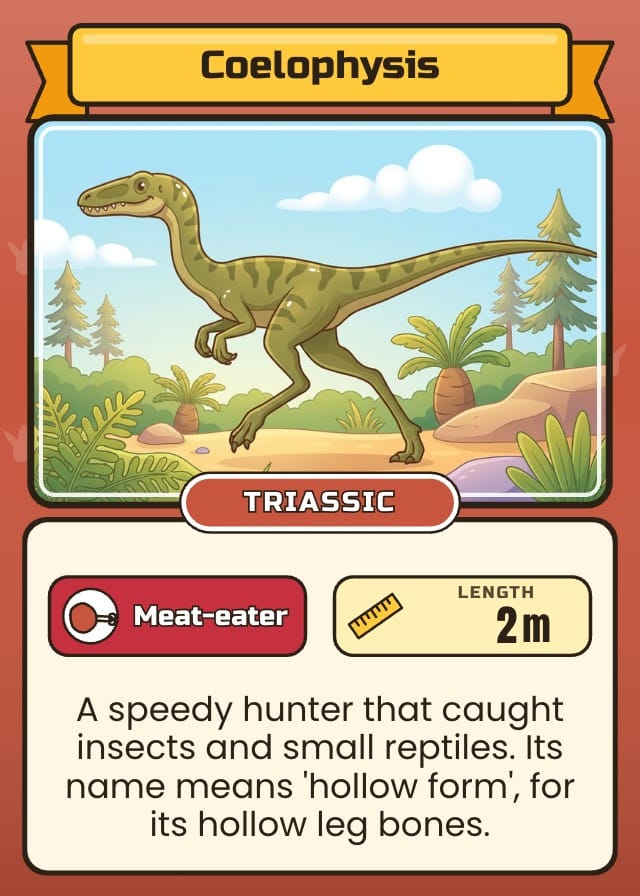
| Coelophysis | A speedy hunter that caught insects and small reptiles. Its name means 'hollow form', for its hollow leg bones. | Meat-eater | Triassic | 2 | Dinosaur | |
| Herrerasaurus | One of the earliest dinosaurs. It is named after Victorino Herrera, the goat herder who found it in Argentina. | Meat-eater | Triassic | 3 | Dinosaur | |
| Plateosaurus | It had five fingers and a big claw on each thumb. So many have been found together in Germany that it may have lived in herds. | Plant-eater | Triassic | 7 | Dinosaur | |
| Staurikosaurus | One of the very first dinosaurs, found in Brazil. Its name means 'Southern Cross lizard', after a pattern of stars. | Meat-eater | Triassic | 2 | Dinosaur | |
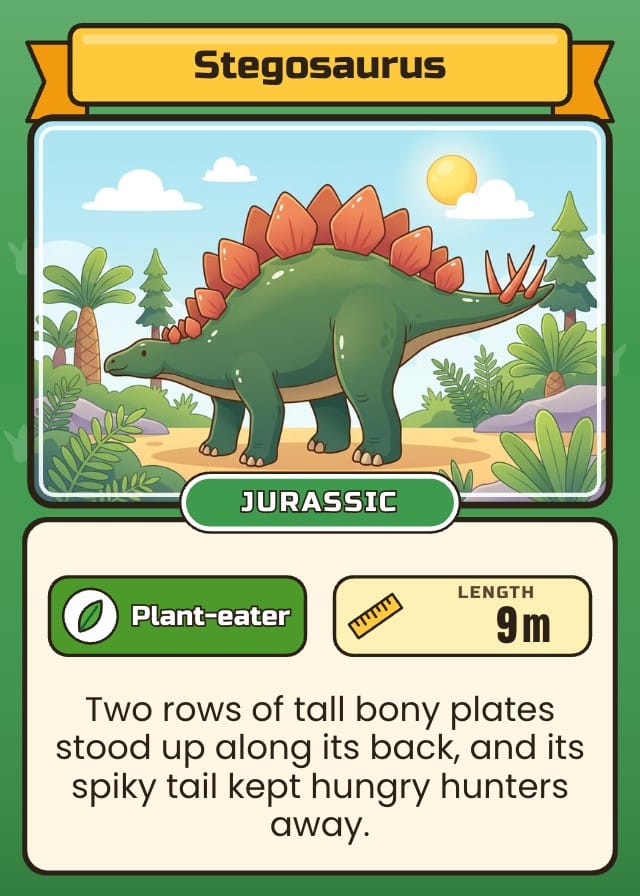
| Stegosaurus | Two rows of tall bony plates stood up along its back, and its spiky tail kept hungry hunters away. | Plant-eater | Jurassic | 9 | Dinosaur | |
| Brachiosaurus | A very tall dinosaur that ate leaves from tall trees. It couldn't chew, so it swallowed its food whole. | Plant-eater | Jurassic | 22 | Dinosaur | |
| Diplodocus | Its tail was very long and thin like a whip. Its name means 'double beam', after the bones under that tail. | Plant-eater | Jurassic | 26 | Dinosaur | |
| Allosaurus | A big hunter with three-fingered hands and small horns above its eyes. It may have hunted Stegosaurus. | Meat-eater | Jurassic | 9.7 | Dinosaur | |
| Apatosaurus | A giant with a long neck and a long tail. Its babies grew up fast and reached full size in about 10 years. | Plant-eater | Jurassic | 21 | Dinosaur | |
| Dilophosaurus | Its name means 'two-crested lizard', for the two crests on top of its head. Nobody knows for sure what they were for. | Meat-eater | Jurassic | 7 | Dinosaur | |
| Archaeopteryx | A small dinosaur with feathered wings. Its name means 'ancient wing', and its first fossil was found in Germany in 1861. | Meat-eater | Jurassic | 0.5 | Dinosaur | |
| Kentrosaurus | A smaller cousin of Stegosaurus, found in Tanzania in Africa. Its name means 'spiky lizard'. | Plant-eater | Jurassic | 5 | Dinosaur | |
| Megalosaurus | The very first dinosaur ever given a name, back in 1824. Its bones were found in Oxfordshire, England. | Meat-eater | Jurassic | 6 | Dinosaur | |
| Ceratosaurus | A hunter with a horn on its nose and a row of small bony bumps running all the way down its back. | Meat-eater | Jurassic | 7 | Dinosaur | |
| Scelidosaurus | One of the early armoured dinosaurs, found in England. Its name means 'limb lizard'. | Plant-eater | Jurassic | 4 | Dinosaur | |
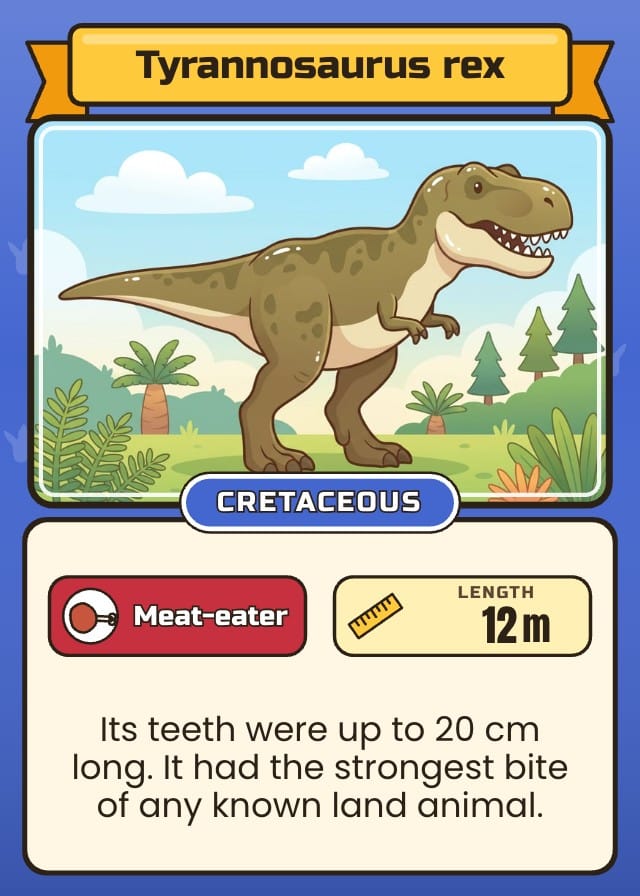
| Tyrannosaurus rex | Its teeth were up to 20 cm long. It had the strongest bite of any known land animal. | Meat-eater | Cretaceous | 12 | Dinosaur | |
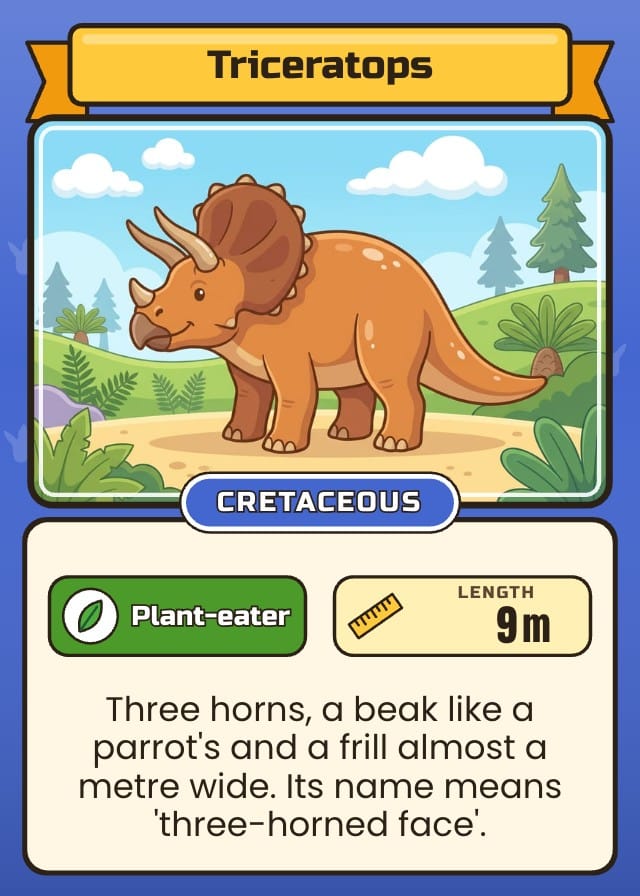
| Triceratops | Three horns, a beak like a parrot's and a frill almost a metre wide. Its name means 'three-horned face'. | Plant-eater | Cretaceous | 9 | Dinosaur | |
| Velociraptor | Smaller than many people think, and covered in feathers. Its name means 'quick plunderer'. | Meat-eater | Cretaceous | 1.8 | Dinosaur | |
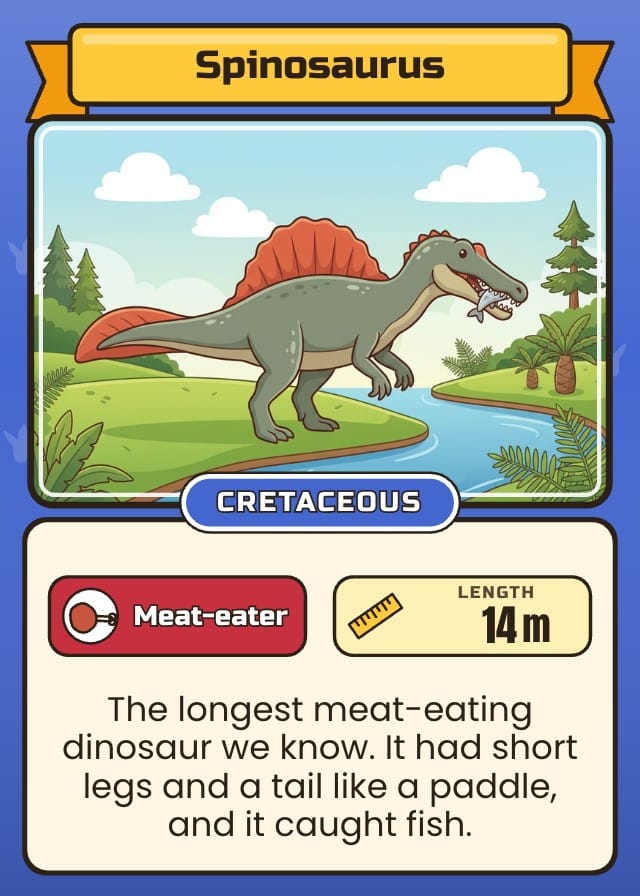
| Spinosaurus | The longest meat-eating dinosaur we know. It had short legs and a tail like a paddle, and it caught fish. | Meat-eater | Cretaceous | 14 | Dinosaur | |
| Ankylosaurus | Bony plates covered its body like armour, and it had a heavy club at the end of its tail. | Plant-eater | Cretaceous | 8 | Dinosaur | |
| Iguanodon | It had a big spike on each thumb, and it could walk on two legs or on all four. | Plant-eater | Cretaceous | 10 | Dinosaur | |
| Parasaurolophus | A duck-billed dinosaur with a long crest on its head. It walked on four legs but could stand up on two. | Plant-eater | Cretaceous | 9 | Dinosaur | |
| Pachycephalosaurus | It had a thick dome of bone on top of its head, and it may have butted heads the way rams do today. | Plant-eater | Cretaceous | 3 | Dinosaur | |
| Argentinosaurus | One of the biggest land animals ever found. Its babies took about 15 years to grow up. | Plant-eater | Cretaceous | 35 | Dinosaur | |
| Giganotosaurus | A giant hunter first found in Argentina in 1993. It was probably longer than T. rex, but not as heavy. | Meat-eater | Cretaceous | 13 | Dinosaur | |
| Maiasaura | Its name means 'good mother lizard'. Its nests, full of eggs and babies, were found in Montana, USA. | Plant-eater | Cretaceous | 9 | Dinosaur | |
| Baryonyx | It had a snout like a crocodile's and a thumb claw about 31 cm long, just right for hooking fish. | Meat-eater | Cretaceous | 10 | Dinosaur | |
| Therizinosaurus | Its hand claws were 50 cm long, the longest of any land animal ever. Its name means 'scythe lizard'. | Plant-eater | Cretaceous | 10 | Dinosaur | |
| Psittacosaurus | Its name means 'parrot lizard'. Its fossils have been found in China, Mongolia and Russia. | Plant-eater | Cretaceous | 2 | Dinosaur | |
| Carnotaurus | Two horns on its head, tiny arms and scaly skin. Its name means 'meat-eating bull'. | Meat-eater | Cretaceous | 8 | Dinosaur | |
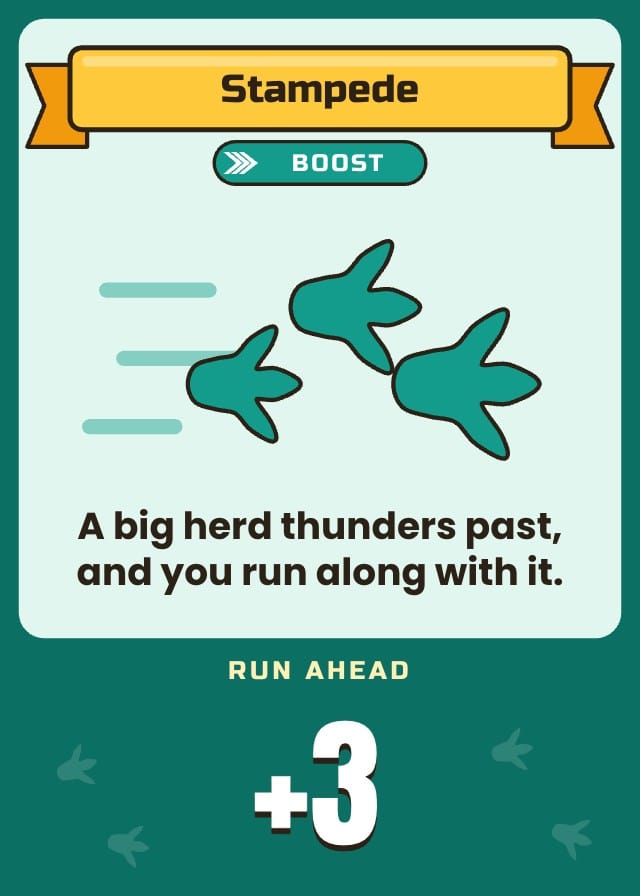
| Stampede | A big herd thunders past, and you run along with it. | 3 | Boost | |||
| Hidden Path | You spot a secret path through the tall ferns. | 3 | Boost | |||
| Log Bridge | A fallen tree makes a bridge over the river. | 2 | Boost | |||
| Muddy Slide | Whee! You slide all the way down a muddy hill. | 2 | Boost | |||
| Tail Wind | A warm breeze blows at your back. Hurry on! | 2 | Boost | |||
| Early Start | The sun wakes you up bright and early. | 1 | Boost | |||
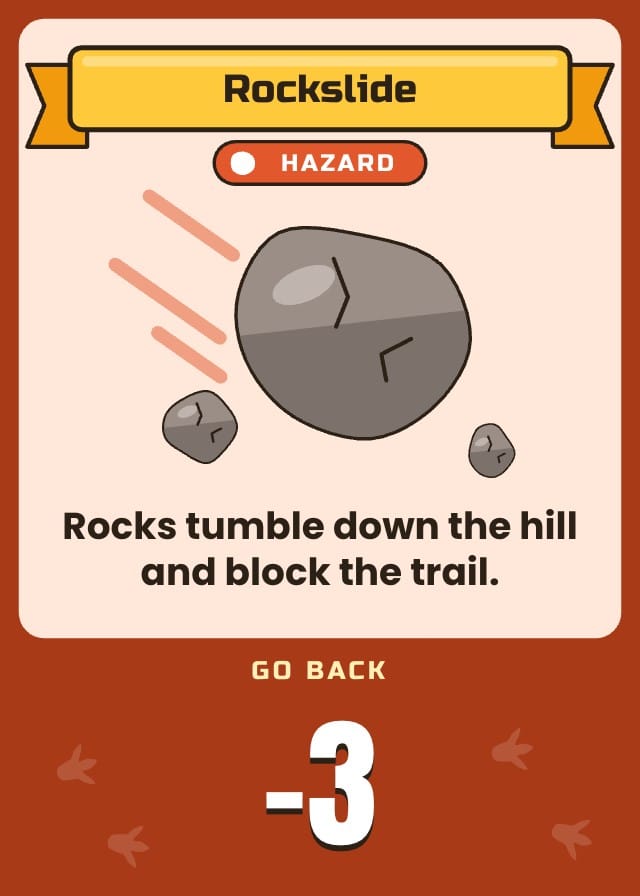
| Rockslide | Rocks tumble down the hill and block the trail. | -3 | Hazard | |||
| Rumbling Ground | The ground shakes! Run back to somewhere safe. | -2 | Hazard | |||
| Swamp Fog | Thick fog rolls in, and you take a wrong turn. | -2 | Hazard | |||
| Thunderstorm | Rain pours down. Go back and shelter under a tree. | -2 | Hazard | |||
| Sticky Mud | Your feet sink in squelchy mud. Step back out. | -1 | Hazard | |||
| Sleepy Time | You curl up for a nap and roll back down the hill. | -1 | Hazard |
How to play Rumblenest
- Shuffle the dino cards and put them face down beside the board. Each player takes a baby dinosaur, slides it into a stand and puts it in the nest.
- On your turn, roll the die and move your dinosaur that many spaces along the trail.
- Stop on a footprint: draw a dino card. On a Boost card, run ahead the number of spaces it shows; on a Hazard card, go back that many. Then put it at the bottom of the pile.
- On a Dinosaur card, the player on your left reads out its name, but not the rest, and asks: plants or meat? Guess right, and keep the card face up in front of you. Guess wrong, and it goes to the bottom of the pile. Either way, they read its fact out loud.
- Stop on a boost space: run ahead 3 spaces. Stop on a lava space: go back 3. Stop in a tar pit: you are stuck, so miss your next turn. Only the space your roll ends on counts, so a space that a card or a boost moves you onto does nothing.
- The first dinosaur to reach the lake ends the race, with no need for an exact roll. Score 1 point for each Dinosaur card you kept, 3 more for every set of one Triassic, one Jurassic and one Cretaceous dinosaur, and 3 for reaching the lake first. Write it on the score sheet; the highest total wins. On a tie, the player with the longest dinosaur wins.
- Playing with younger children? Skip the guess and keep every Dinosaur card you draw.
Printing the boards, cards, tokens, dice, score pads and boxes
Boards: Square Board, 8 × 8 in, 203.2 × 203.2 mm, 2400 × 2400 pixels at 300 DPI. With an eighth of an inch of bleed on every edge, a board goes out as 2475 × 2475.
Cards: Poker, 2.5 × 3.5 in, 63.5 × 88.9 mm, 750 × 1050 pixels at 300 DPI. With an eighth of an inch of bleed on every edge, a card goes out as 825 × 1125.
Tokens: Medium Standee, 0.75 × 1.68 in, 19.1 × 42.7 mm, 225 × 504 pixels at 300 DPI. With an eighth of an inch of bleed on every edge, a token goes out as 300 × 579.
Dice: D6, 0.6 × 0.6 in, 15.2 × 15.2 mm, 180 × 180 pixels at 300 DPI. With an eighth of an inch of bleed on every edge, a die goes out as 255 × 255.
Score Pads: Small Score Pad, 3.5 × 5.5 in, 88.9 × 139.7 mm, 1050 × 1650 pixels at 300 DPI. With an eighth of an inch of bleed on every edge, a score pad goes out as 1125 × 1725.
Boxes: Poker Tuck Box, 54 cards, 7.75 × 6.5 in, 196.9 × 165.1 mm, 2325 × 1950 pixels at 300 DPI. With an eighth of an inch of bleed on every edge, a box goes out as 2400 × 2025.
On the Hobby plan, export a print-ready PDF with bleed and cut lines, each part at its own size. PNG and SVG come out at the same sizes, which is what Tabletop Simulator wants. On Indie, send the game to a print-on-demand partner through Print & Ship. The export adds the bleed: let the artwork run into it and keep the text inside the cut line.
How to design a board game, from the first rule to a printed copy
Questions about Rumblenest Dinosaur Board Game Template
Everything you need to know before getting started.
Still have questions? Contact us
Can I play the dino cards as a dinosaur card game on their own?
Yes. The 30 Dinosaur cards work without the board: one player reads a card's name, another guesses plants or meat, and a right guess keeps the card. A set of one Triassic, one Jurassic and one Cretaceous dinosaur scores extra, as it does in the board game.
Are the dinosaurs on the cards real?
Yes. Every Dinosaur card is a real dinosaur, from Coelophysis to Tyrannosaurus rex, with its period, its length in metres, whether it ate plants or meat, and a fact about it.
What happens when I add Rumblenest Dinosaur Board Game Template to a project?
The one board design, four card designs, one token design, six die designs, one score pad design, one box design, their fields, one sample board, 42 sample cards, four sample tokens, one sample die, one sample score pad and one sample box are copied into one project of yours, with the fields already pointed at the designs: the boards in a collection of their own, the cards under All cards, the tokens in a collection of their own, the dice in a collection of their own, the score pads in a collection of their own and the boxes in a collection of their own. Nothing stays linked to this page afterwards, so the author's later edits never reach your copy.
What size does Rumblenest Dinosaur Board Game Template print at?
The boards are Square Board size, 8 × 8 in, 203.2 × 203.2 mm, 2400 × 2400 pixels at 300 DPI. The cards are Poker size, 2.5 × 3.5 in, 63.5 × 88.9 mm, 750 × 1050 pixels at 300 DPI. The tokens are Medium Standee size, 0.75 × 1.68 in, 19.1 × 42.7 mm, 225 × 504 pixels at 300 DPI. The dice are D6 size, 0.6 × 0.6 in, 15.2 × 15.2 mm, 180 × 180 pixels at 300 DPI. The score pads are Small Score Pad size, 3.5 × 5.5 in, 88.9 × 139.7 mm, 1050 × 1650 pixels at 300 DPI. The boxes are Poker Tuck Box, 54 cards size, 7.75 × 6.5 in, 196.9 × 165.1 mm, 2325 × 1950 pixels at 300 DPI. Those are the numbers to hand a print shop, and each part exports at its own size.
Is Rumblenest Dinosaur Board Game Template free?
Yes. Adding it, editing it, filling it with your own cards and playtesting it online are all free. Exporting print files starts on the Hobby plan, and Print & Ship through The Game Crafter is on Indie. No template sits behind a paid plan.
Can I change the designs?
Yes. They land in your project as ordinary layouts, so you can drag an element somewhere else, put your own art behind the frame, restyle the type or rename a field. Edit a design once and every board or card or token or die or score pad or box drawn on it follows.
Can I use my own boards, cards, tokens, dice, score pads and boxes instead of the samples?
Yes. The boards, the cards, the tokens, the dice, the score pads and the boxes each have a sheet, and the samples are rows in them, there to be overwritten. Type over them, add rows of your own, or bring a CSV and match its headers to the fields.
Can I sell a game made with Rumblenest Dinosaur Board Game Template?
Yes. This one is ours, and you keep commercial rights to what you build from it, crowdfunding and retail included.
Ready to make your own board game?
This template is free, and so is the editor it opens in.